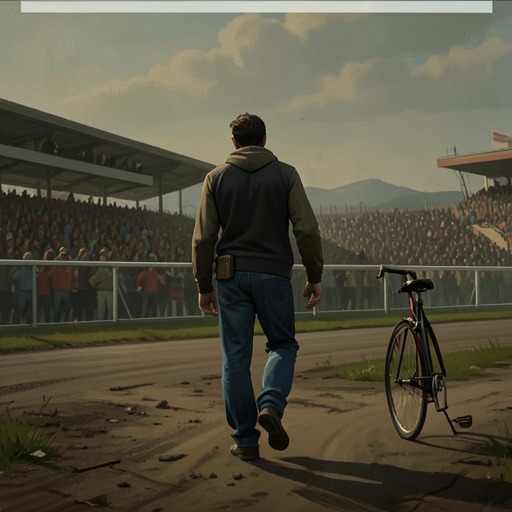
Vélodrome d’Hiver
A Moveable FeastVélodrome d’Hiver is an indoor cycling track recalled through the distinctive sounds and physical intensity of racing: smoky afternoon light, a high-banked wooden course, and tires whirring over the boards. It represents a later part of the narrator’s Paris life, and a subject whose power in memory repeatedly exceeded his attempts to capture it in stories.
Setting and Physical Character
The track is defined by a handful of exact, forceful impressions. Its afternoon light is smoky; its wooden course rises in a high bank; and the riders’ tires make a whirring sound as they pass over the wood. These details give the venue a character built not from a general description of Paris but from the conditions of watching racing: enclosed light, steep turns, and the noise of speed.
The track’s wooden surface also belongs to a broader description of cycling as an intensely physical sport. Riders climb and plunge around the banking, their effort and tactics visible in the way they move with their machines. The venue is not simply a backdrop for competition: its shape and surface help make the racing’s speed, danger, and exertion legible to spectators.
Racing and Spectacle
The narrator associates Vélodrome d’Hiver with the demi-fond, a form of racing paced by motorcycles. The motorcyclists ride ahead in heavy crash helmets and leather suits, leaning backward to shelter the cyclists following them from air resistance. Behind them, the riders bend low over their handlebars, turning huge gears as their small front wheels follow the rollers behind the pacing machines. The race becomes a contest of proximity and endurance, with riders moving elbow to elbow and wheel to wheel at deadly speed.
In that contest, shelter from the air is temporary. When a rider can no longer hold the pace and breaks away, the wall of air that the motor had been shielding him from strikes him directly. The Vélodrome’s spectacle therefore depends on more than speed alone: it is made from tactics, physical strain, and the sudden cost of losing position.
Place in Paris Memory and Writing
Bicycle racing entered the narrator’s life gradually. For a long time, returning to his own part of Paris and attending to work, life, and familiar painters mattered more than going to the track or trying to make a living by gambling. Racing became a larger part of life later, when the first part of Paris had broken up. Vélodrome d’Hiver belongs to that later sporting world, in contrast to the earlier routine the narrator describes as a return to his neighborhood and work.
The venue also marks a persistent gap between experience and literary achievement. The narrator had started many stories about bicycle racing but had not written one as good as the races themselves. He could already recall the Vélodrome’s smoky light, high wooden banking, and whirring tires, and could set out the tactics of motor-paced racing in detail; yet he still treats the track and its racing as material he has not fully mastered in prose. Its significance lies partly in that unfinished promise: the remembered scene is vivid, while the story capable of matching it remains unwritten.